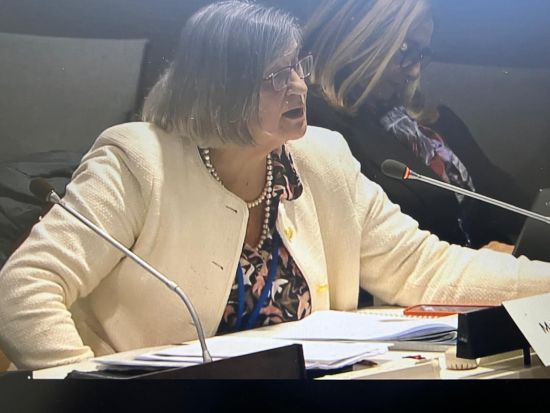
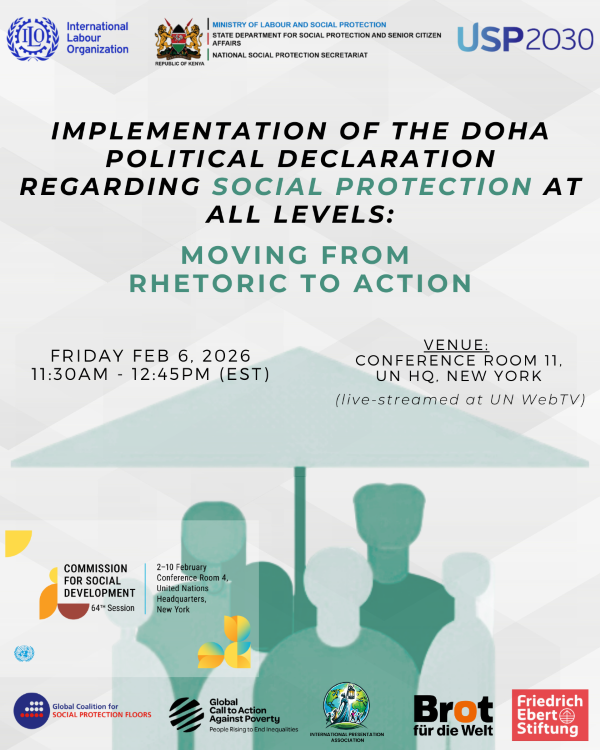
Sylvia Beales spoke on behalf of the Global Coalition for Social Protection Floors (GCSPF) and the Global Call to Action Against Poverty (GCAP) at the side event “Implementation of The Doha Political Declaration Regarding Social Protection at All Levels: Moving from Rhetoric to Action”. The side event was held on Friday, February 6, 2026, at the UN Headquarters, New York, during the 64th session of the UN Commission for Social Development (CSocD64) which is taking place in the United Nations Headquarters in New York from 2 to 10 February 2026.
Watch the recording of the side event, Download the Statement, watch her intervention.
|
Question
Across the life course millions of women and girls have no or limited access to social protection. Social protection is often seen as a cost rather than an investment, as a privilege rather than a human right.
How does the Doha Political Declaration help us shift this narrative and design, implement and monitor age-, disability- and gender-responsive schemes that support women and girls in all stages of life, demonstrating that the right of all to social protection is fundamental to social inclusion?
GCAP and the Global Coalition for Social Protection Floors (GCAP) welcomes the focus of this Commission on coordinated and inclusive policies to advance pathways to poverty eradication and equality and is very happy to be part of this distinguished panel.
The Doha Political Declaration expresses a strong political consensus on social protection – it has 26 mentions – and on the specific target for increasing social protection. A recognition that social protection is both a right and is foundational for equitable and sustainable social development.
The Declaration asserts that universal, rights-based social protection is necessary and affordable. Also, that it is a no brainer in that it is one of the most powerful tools we have to end poverty and reduce inequalities. Many member States have said so this week, and that social protection goes hand in hand with investing in care, both necessary for economic growth, solidarity between countries and people and fundamental for social justice.
Yet the dilemma is that billions of people, with this burden falling heaviest on women and girls, remain unprotected, excluded, and left behind. Budgets are not yet in place to deliver on the commitments.
As the Doha Declaration makes clear this imperils the SDGs and is both a clear violation of the universal right of all to social protection and to ILO standards.
So the question is to how can the narrative and practice be shifted so it is no longer necessary endlessly to argue that social protection is a cost rather than an investment – a handout as opposed to a hand up? How can we governments implement their promises?
We have heard compelling examples given here, in this event and during the Commission, and have before us the persistent work of champion governments that work with the ILO, in USP 2030 and regional commissions. Many Member States have given very strong and supportive statements for social protection during the days of this Commission, with human rights, dignity, equality, reaching all across the life course and gender justice given much emphasis. This is very encouraging.
Therefore, to deliver on past commitments and to prepare for a new era of universal social protection beyond 2030, GCAP and the Global Coalition are emphasizing the following:
In the first place to call on all governments to develop national implementation and financing plans for universal social protection floors. Many have done so. Those who have not yet we propose to agree to do by the end of 2028. These plans shall include time-bound tarets until when universal social protection shall be achieved. They must be grounded in human rights, build on existing schemes and be joined up, and designed to ensure that everyone, without exception, is covered across the life course. This requires addressing and dismantling intersectional barriers, including those linked to gender, disability, age, migration status, ethnicity, and socioeconomic background. Social protection systems cannot be universal if they are not inclusive. To truly leave no one behind, they must be accessible, adequate, adaptive, and responsive to the needs of all people in all their diversity.
Second that all stakeholders, civil society in partnership with government, have a clear and joint focus on accountability – meaning monitoring the implementation of social protection commitments made in the Doha Declaration. Again this is real and focused work to look together at evidence and data and have grassroots, bottom-up conversations about gaps, barriers and people centered solutions and strategies. We can all partner to contribute expertise, effort and data to assess, report on progress and gaps. We must not be shy, or afraid of holding our governments and policy makers accountable for their promises.
Third we must call into question the excuse of many countries that domestic resources are insufficient to expand and achieve universal social protection. But this is also about political choices and global rules. Domestic taxation, ending illicit tax flows, climate reparations and payment of taxes by business is part of the financing picture. At the global level, the ongoing UN tax negotiations are a major opportunity to help countries raise sustainable revenue for rights and services. Today, governments lose an estimated USD 312 billion annually in corporate tax revenues due to profit shifting by multinational enterprises—twice the total outstanding loans by the IMF. Those are resources that could finance universal social protection and essential public services. International financial institutions and the international community also have responsibilities: financial and technical support must be coherent, predictable, and human-rights-based, and must enable expansion of universal systems, not impose austerity or conditionalities that undermine social protection or public services,
Fourth Doha and this Commission calls for regular follow‑up and review of the commitments made, including at the regional level, with a review in 2031 which can only strengthen accountability across governments and the UN system. We will look to see that this review process - national, regional and global – encourages Member States to demonstrate concrete progress, identify remaining gaps, and outline corrective actions. And clearly link these reviews to SDG achievement.
Fifth we are looking for meaningful and inclusive consultations with civil society, trade unions, community-based organizations, and groups of self-advocates, including Organizations of Persons with Disabilities, older persons, women and children and youth. Their participation is essential to assess whether social protection systems are truly universal, accessible, and responsive to intersecting forms of discrimination, essential to ensure that commitments translate into real improvements in people’s lives and that no one is left behind.
Finally, there is a broader political warning we cannot ignore. Recent analysis by UN Special Rapporteur Olivier De Schutter underscores that sustained welfare retrenchment and cuts—often justified through austerity narratives—can erode trust, deepen insecurity, and help fuel divisive politics, including the rise of far-right populism. Investing in universal, rights-aligned social protection is not only about poverty reduction, it is also about social cohesion and democratic resilience.
Universal and inclusive social protection floors are not optional, they are indispensable. They are a foundation for human dignity, social cohesion, resilience, and sustainable development.
GCAP and the Global Coalition for Social Protection Floors (GCSPF) stand ready to support Member States in building systems that protect everyone, address intersecting forms of discrimination, and ensure that no one is left behind.
Key message
The Side event was organized by the Kenyan Government, USP 2030, International Labour Organization (ILO), Global Coalition of Social Protection Floors (GCSPF), Global Call to Action Against Poverty (GCAP), International Presentation Association (IPA), Bread for the World, Friedrich Ebert Stiftung.
Further information: Recording, Invitation, Flyer and Concept note.
Civil Society Call for a Global Fund for Social ProtectionCivil society organizations and trade unions unite to call for a Global Fund for Social Protection to protect the most vulnerable.Social Security for AllCivil society organizations and trade unions call governments and international financial institutions to make a commitment to create social security systems that enable everyone to realize their rights. Governments and financial institutions should end policies that have been failing millions of people.SP&PFM ProgrammeThe programme Improving Synergies Between Social Protection and Public Finance Management provided medium-term support to multiple countries aiming to strengthen their social protection systems at a national level and ensure sustainable financing. The programme aimed to support countries in their efforts towards achieving universal social protection coverage.This initiative was implemented jointly by the ILO, Unicef, and the GCSPF. Desarrollo Web: icodemon.com.uy |