The analysis, Social Protection: What Role for Civil Society? just released by the GCSPF, seeks to deepen the understanding of the multiple functions of civil society in social protection and to highlight the importance of this diversity in strengthening social protection systems, also through providing examples from across the world. It primarily addresses national and international civil society actors – both those who are already engaged in social protection and those who wish to do so, as well as government actors and development partners. While these arguments are not new, this paper draws attention to the underutilized potential of civil society actors in strengthening and safeguarding social protection systems.
POLICY ANALYSIS
SOCIAL PROTECTION. WHAT ROLE FOR CIVIL SOCIETY? AN ANALYSIS
Barbara Rohregger
Table of Contents
1. Introduction
2. Social Protection: Definitions & Functions
3. The multiple roles of CSOs in social protection
3.1. Civil society organizations as a mouthpiece
3.2. Agenda setting: Civil society and its role in political dialogue
3.3. Civil society as a policy entrepreneur
3.4. Civil society as a "gap-filler" implementation partner and service provider
3.5. Civil society as a watchdog
4. Challenges
4.1. Lack of integration
4.2. Reduced scope for action
4.3. Degree of organization and social protection expertise
4.4. Cooperation vs. cooptation
5. Towards a more Inclusive Governance in Social Protection
5.1. Creating a regulatory and legal framework to enable social dialogue and integrated service delivery
5.2. Broader view of civil society engagement in social protection
5.3. Expanding networks and alliances: leveraging diversity
5.4. Coalition building at the local, regional and international level: Strengthening vertical social protection governance
5.5. Strengthening civil society for social protection: The role of development partners and international NGOs in strengthening social protection governance
Literature
Civil society organizations are crucial actors in social protection. NGOs and social movements, trade unions, associations, mutual-health insurance schemes, cooperatives or community-based organizations - all play an important role in delivering, advocating or monitoring social protection. This is the case both for highly formalized welfare states and for countries, where social protection mechanisms are predominantly informal.
Civil society organizations are critical actors in the provision of social services addressing poverty, social exclusion and (health) care, complementing public service delivery or filling implementation gaps by the state or other actors. They tend to provide support to groups where the state does not reach, such as people living in the streets or in prison. Their close engagement with communities and intimate knowledge of communities' needs and challenges in accessing social protection, makes them sought-after government partners for designing social protection policies and programs. At the same time, they are an important mouthpiece for marginalized groups who otherwise would not have a platform for representation. They make sure that governments are held accountable for delivering sound and adequately financed social protection measures, defend their rights and interests or draw attention to their social and economic conditions, generating political and social pressure on governments or the international community for reforms (Huyse 2021).
The extent to which civil society organizations act upon these multiple roles depends on their specific objectives and varies across contexts. In established welfare states, as in the case of Germany, civil society organizations often occupy a recognized position within the welfare system. They have a contractual arrangement with the state largely substituting public service delivery (Wollmann 2018) while having an important advocacy function for social protection. In low-income countries, civil society organizations often take over similar functions, without, however, benefiting from a recognized role or financial compensation in the social protection system. For many, the service delivery role is predominant – often reinforced through government policies and funding and support strategies of international development partners and NGOs. This limits the potential of CSOs in defending, promoting and negotiating the right to social protection and its implementation.
This analysis seeks to deepen the understanding of the multiple functions of civil society in social protection and to highlight the importance of this diversity in strengthening social protection systems, also through providing examples from across the world. It primarily addresses national and international civil society actors – both those who are already engaged in social protection and those who wish to do so, as well as government actors and development partners. While these arguments are not new, this paper draws attention to the underutilized potential of civil society actors in strengthening and safeguarding social protection systems.
This is of particular relevance against the current backdrop of the impending debt crisis, forced austerity and massive aid cuts which substantially reduce the fiscal space for civil society organizations, putting at risk the survival of many NGOs, in particular local and community-based organizations. This development is often accompanied by a shrinking political and regulatory space of civil society organizations, including legal frameworks governing NGO funding and operations in various countries (e.g. Cameroon and Ethiopia) (Kongere 2025).
2. Social Protection: Definitions & Functions
Social protection is a human right. Through a range of instruments and measures such as social health and pension insurance, cash transfer programs, and labor market policies it enables people to protect themselves against major life-cycle risks, including illness, unemployment, and poverty in old age. Social protection therefore makes a vital contribution to combating poverty, hunger and inequality. It improves opportunities for participation in the economy and society, particularly for groups that are otherwise excluded, contributing to inclusive and sustainable economic development (BMZ 2023; Schüring and Wiebe 2021).
Social protection encompasses a broad set of measures and instruments. They can be distinguished according to their form of financing and their objectives.
Figure 1: Classification of social protection instruments
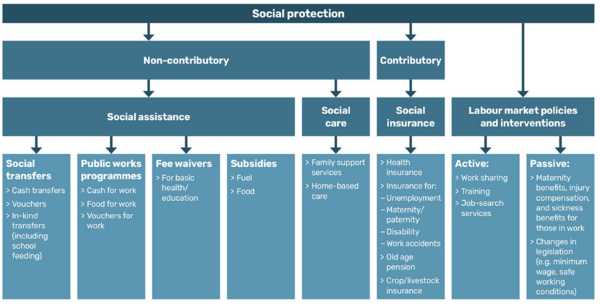 |
Source: Topic Guide 2019, adapted from O'Brien et al. (2018: 6).
Social protection systems encompass the full range of programs designed to cover all life-cycle risks and are ideally grounded in a legal entitlement. Their primary aim is to better coordinate and integrate existing programs, thereby improving long-term access and ensuring that benefits are delivered efficiently, transparently, and in a timely manner. In addition to public actors, such as social security institutions, social protection systems include private partners (e.g. companies, financial institutions, and commercial service providers); civil society (e.g. trade unions, NGOs, and social movements); and informal actors (families/households, informal social networks). They all play distinct roles in the coordination, implementation, maintenance, and financing of social protection systems.
The coordination and regulatory functions are primarily the responsibility of the state, which manages and oversees the diverse actors and programs at the local, regional, and national levels. Regulatory frameworks usually define what programs exist, for which target group and with what scope of services. They also regulate how different actors in the system are supposed to collaborate and how programs are financed. Beyond financial and administrative guidelines, they may also incorporate quality standards to ensure the services provided by non-governmental actors meet defined criteria.
Although funding mechanisms for social protection systems vary by context, they are usually based on a mix of sources. Government subsidies from public revenues and taxes usually account for the largest share (including donor funding in low-income countries), supplemented by social security contributions from employees and employers, as well as direct private co-payments for specific services, such as those in the health care sector (out-of-pocket payments) (Schüring and Wiebe 2021).
Social protection is a human right and is enshrined in the Universal Declaration of Human Rights (1948) and the International Covenant on Economic, Social and Cultural Rights (ICESCR) (1966). Social protection is an inherent part of the relationship between the state and its citizens (social contract). The state has an important duty of care towards its citizens. This applies in particular to the most vulnerable sections of the population. In a range of countries, the right to social protection is also enshrined in their constitution (e.g. Italy, South Africa, Cambodia, and Pakistan).
Social protection plays an important role in relation to the 2030 Agenda and its core principle of 'leaving no one behind'. It contributes directly and indirectly to the achievement of several SDGs and their targets, in particular goals 1.3 (implementation of a social protection floor for all), 3.8 (achievement of universal health coverage), 5.4. (recognition of unpaid care and domestic work as gainful employment with corresponding social protection), 8.5 (productive full employment and decent work for all), and 10.4 (implementation of fiscal, wage, and social protection measures with the aim of achieving greater equality).
Social Protection and its functions
Protective: The primary purpose of social protection is to protect people against situations of poverty and social exclusion throughout their life-cycle. Social protection measures are thus essential throughout an individual’s life. While social protection is important for all people, people in precarious situations are often exposed to higher risks and are more vulnerable, making their access to social protection particularly critical. Direct transfer payments, such as cash or in-kind transfers, are key instruments for stabilizing income and enabling individuals to cope with economic crises or natural disasters without having to significantly reduce consumption or liquidate important assets, such as livestock, land, or other productive resources.
The economic crisis of 2008, but above all the COVID-19 pandemic, have shown that countries with a basic social protection scheme in place were better equipped to cope with the consequences of large-scale collective shocks, demonstrating the important stabilizing function of social protection (Gentilini 2022). This also concerns the climate-related context, where social protection is used to cope with large-scale shocks, such as floods or droughts (e.g. World Bank 2018; BMZ 2023b).
Preventive: Social protection increases equal opportunities for individuals and families and improves the chances of breaking the cycle of intergenerational poverty through decreasing vulnerabilities in the long-term (ex-ante, i.e. before risks materialize). Social health insurance, for example, allows for free and adequate health care for the whole family, thereby mitigating the risk of sickness. The same holds for other types of insurance, such as old-age or agricultural insurance. Other examples are saving schemes or other types of income diversification (Devereux and Wheeler 2004).
Promotive: Social protection supports marginalized groups to participate in economic development and inclusive growth thereby contributing to an inclusive society and a sustainable economy. By linking cash transfers with complementary measures, such as professional training, fertilizer, land, or livestock, access to savings and credit products, social protection helps to strengthen livelihoods in a sustainable manner. This makes an important long-term contribution to individual and societal development.
Transformative: Social protection has an important emancipatory and transformative dimension by addressing existing social and economic inequalities (ibid.). When access to food, education, and health care is guaranteed, opportunities for self-help and self-determined participation in the economy, society, and politics open up, even for the most marginalized. This enables emancipatory development. Transformative measures, such as the establishment of social policy frameworks and laws aimed at reducing the structural causes of poverty, can reinforce these effects, for example by strengthening labor rights, setting a minimum wage, or expanding political rights by establishing social dialogue at the national level.
Redistributive: Although not a function in the narrow sense, redistribution is an important feature of social protection. In many societies, well-being shows a clear gradient, with better-off people being healthier, more educated, and more productive than people from lower-income groups. Where tax and social protection systems are progressive in design, meaning that higher-income groups are asked to contribute more in terms of taxes or social security contributions than lower-income groups, social protection can contribute to the redistribution of financial and social resources across different income groups. This can help to reduce the gap, while at the same time strengthening solidarity and social cohesion across society and contributing to inclusive growth.
3. The multiple roles of CSOs in social protection
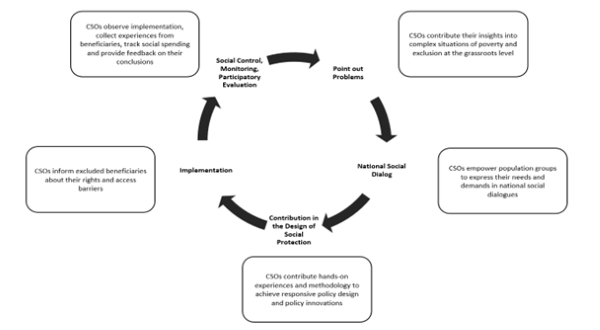
Civil society engagement in social protection has a long tradition which in many countries far exceeds the commitment of the state (Cammett and Mac Lean 2014)1. Civil society organizations differ in size and organizational degree ranging from self-help groups, local neighborhood support groups, and cooperatives to welfare and religious associations, NGOs, and trade unions, some of them highly organized and with a global reach. While some of them pursue highly specific purposes in social protection, for example NGOs engaged in advocacy work (FES 2015), most of them fulfill multiple functions simultaneously. Allocating the diverse roles of civil society organizations along the stages of the classical policy cycle, Vaes et al. (2016) identify five main functions of civil society for social protection2:
Figure 2: The different roles of civil society in shaping social protection systems in the policy process Based on Vaes et al. 2016
 |
3.1. Civil society organizations as a mouthpiece
Civil society organizations tend to have a strong social and geographic proximity to the groups they represent. This makes them important intermediaries in social protection between the state, which is often distant or perceived as such and the target groups. Civil society organizations raise awareness among vulnerable groups about their rights to social protection, informing them about their entitlements to services and programmes, and about how to overcome barriers in accessing them (Heyse 2021; FES 2015). At the same time, they function as a mouthpiece, voicing concerns around social and economic conditions of the groups they represent or general social justice issues and showing how social protection can help address these conditions (FES 2015; Schüring and Wiebe 2021).
The One Billion Dollar Question The Inter-Religious Standing Committee for Economic Justice and Creation Care (ISCEJIC) is a committee composed of representatives from the Tanzania Episcopal Conference (TEC), the National Muslim Council of Tanzania (BAKWATA), and the Christian Council of Tanzania (CCT). The committee was established to work together more effectively for social and economic justice. In 2012 and 2017, the Interfaith Committee published reports entitled "The One Billion Dollar Question: How can Tanzania Stop Losing So Much Tax Revenue." The report shows that Tanzania lost around $1.83 billion in tax revenue in 2017, mainly through tax evasion, capital flight, and the granting of tax incentives. This amount could, for example, triple spending on health care. The report sparked public debate and raised awareness among policymakers of the urgent need to establish tax justice in order to finance access to healthcare and social security. |
Civil society organizations also raise awareness of the potential impacts of social protection and wider economic policies through targeted media campaigns, political education, or research activities - for example on the vulnerabilities of marginalized groups or the social impacts of certain policy reforms. The formation of alliances and networks is key for effective communication and may extend beyond the national level to regional or global scale. Jointly raising awareness of problems in order to build public pressure and lobby for specific approaches or issues is particularly important for small, less established civil society organizations (Huyse 2021).
3.2. Agenda setting: Civil society and its role in political dialogue
Civil society organizations are important in building social and political pressure for specific issues and concrete demands through lobbying and advocacy work, thereby influencing and accelerating political decision-making (Vaes et al. 2016 in Briones Alonso and Van Ongevalle 2023). Apart from research and evidence-generation, this includes continuous networking, the engagement in high-profile campaigns and activities such as demonstrations, sit-ins and occupations of strategic institutions, strikes, or the boycotts of products and services (FES 2015). They usually target national governments, sub-national administrations, specific decision-makers, and the private sector and its representative organizations, such as employers’ organizations (Matuschek et al. 2021), but may also go beyond the national level addressing international bodies and the donor community.
Global Coalition for Social Protection Floors (GCSP) The Global Coalition for Social Protection Floors (GCSP) comprises more than 140 NGOs, think tanks and trade unions advocating for the implementation of Recommendation 202 on Social Protection Floors (International Labour Organization). The GCSPF encourages debate and positive action on human rights-based social protection floors and social protection systems through research dissemination, political advocacy and dialogue as well as collective action. |
Social media platforms have substantially changed the way civil society organizations are organizing and conducting campaigns or forging alliances with other CSOs. The new technologies have created new opportunities by allowing for campaigns to expand easily from regional or national to global scale, thereby raising awareness of certain issues or topics on a much wider scale.
WIEGO, STREETNET AND ITUC-Africa WIEGO (Women in Informal Employment: Globalizing and Organizing) and STREETNET, the largest global alliances of trade unions and associations of informal workers, organized the first African regional conference on social protection for informal workers in spring 2023. The aim of the conference was to strengthen knowledge about social protection among partner organizations, promote the formation of networks, and develop a regional position on social protection for informal workers, in cooperation with, among others, the regional organization of the International Trade Union Confederation (ITUC-Africa). One result of the conference was the establishment of a regional platform for social protection recommendations, with the aim of supporting national trade unions and civil society organizations in their demands for improved social protection for informal workers and raising awareness of this issue among governments and supranational organizations. |
At the same time, the use of social media platforms for campaigning has created new challenges for CSOs that undermine their action: surveillance, targeted censorship to control narratives or disinformation campaigns, where false narratives are spread to discredit civil society organizations. Internet shutdowns and content bans, where platforms remove advocacy messages under vague or arbitrary policies, are used to suppress advocacy. The monitoring of digital activities further exposes CSOs to targeted repression undermining their efforts to raise awareness of social protection and fight for labor rights for the most vulnerable (FORUS 2025).
3.3. Civil society as a policy entrepreneur
Civil society organizations are important drivers of innovation in social protection programming and policy making. Many of them are home-grown and, thus, have an in-depth knowledge of the local context and the challenges related to accessing social protection for their target groups. This often leads them to look for innovative and flexible solutions. Their small size and their flexible organizational structures allow them to implement, test, and improve new approaches on a small scale rendering them important innovation labs for inclusive and equitable solutions on a large scale (e.g. BRAC 2026; Oxfam 2026; WIEGO 2025). Civil society organizations thus have extensive knowledge and experience to proactively contribute to innovative policy solutions and reform efforts, often more quickly and effectively than government structures could (ILO 2020). In various countries this expertise translates into NGOs being a sought-after partners in shaping and critically examining legislative initiatives or proposals for new social policy measures, identifying gaps, and suggesting improvements.
Campaign for Clean Clothes – Clean Clothes Germany The Clean Clothes Campaign Germany advocates for the labor and human rights of the predominantly female workers in the textile, clothing, and sporting goods industries worldwide. The aim of the campaign is to create decent working conditions based on the conventions of the International Labor Organization (ILO) of the United Nations, such as the right to freedom of association, the right to collective bargaining, minimum age, living wages, safety and health at work, working time regulations, and the prohibition of forced labor and discrimination. The campaign's main target audience is companies in the textile value chain. They should commit themselves, or be obliged by changes in the legal framework, to guarantee decent working standards in the manufacture of all their products and have this monitored by an independent body (Clean Clothes Germany 2023). Sports and fashion events, such as world championships, the Olympic Games, and fashion weeks, are regularly the scene of public actions by the campaign. The adoption of the International Agreement on Safety and Health in the Textile and Garment Industry in 2021 is one of the campaign's greatest successes. It promotes workplace safety through independent safety inspections, training programs, and a grievance procedure for workers (International Accord 2023). |
The social dialogue is a specific way through which CSOs are shaping social protection policies. It is a cornerstone of the ILO’s mission and includes all types of negotiation, consultation and exchange of information between or among representatives of governments, employers and workers on issues of common interest relating to economic and social policy, based on the tripartite principle (ILO 2026). While the model may vary across contexts, it is an institutionalized space in which social partners (employee and employer associations) actively participate in shaping social and employment policy and is legally enshrined in many countries and, for example, at the EU level. With the increase in precarious and informal employment relationships, such as temporary work, one-person companies, €1 jobs3, or platform workers since the early 2000s, the question of how to include these new occupational groups, which are considered unorganized and thus excluded from traditional trade unions and formal negotiation processes, into the social dialogue is becoming increasingly important (Jährling et al. 2016; Brinkmann et al. 2006; Bispinck and Schulten 2011).
The question of how to expand the social dialogue to include informal workers and employers is of even more relevance in middle- and low-income countries where informal employment far exceeds formal working relationships. An increasing number of initiatives and platforms at the national and international level seek to strengthen the coalition between established social partners and civil society organizations, especially in the context of social and labor market policy issues. Civil society thus actively contributes to policy diffusion or policy transfer from the bottom up (Vaes et al. 2016; Briones Alonso and Van Ongevalle 2023). This can also extend beyond the national level. One example is the global diffusion of the BRAC Ultra-Poor Graduation Approach, which was developed in Bangladesh and is now being implemented in 50 countries, including by other organizations (BRAC International 2026).
3.4. Civil society as a "gap-filler" implementation partner and service provider
NGOs have always been important actors in the provision of social services. In many countries, this is still the case. Religious organizations, for example, continue to be pivotal in managing kindergartens, schools, and hospitals or offering health services. The function of civil society as a service provider may vary from (1) filling gaps where government services are limited or not available, to (2) acting as an implementation partner with the aim of complementing government services in a meaningful way, or (3) acting as a fully-fledged service implementation partner providing services on behalf of the state based on a contractual arrangement.
Particularly in countries where administrative and service structures are weak, civil society organizations are important providers of front-line services often complementing state services or completely substituting them. They implement social protection programs in their entirety or may take on specific operational tasks supporting state structures during implementation (e.g. targeting and enrolment campaigns, data collection and verification, or payment services). This also includes mutual or community-based health insurance schemes. These are voluntary, member-based insurance schemes with a limited geographic reach. They are financed by contributions from their members and guarantee free access to basic health services, including preventive measures, for their members and their families (e.g. Senegal, Rwanda) (MSH 2016; Ly et al. 2022). Despite significant challenges, including unaffordable membership fees for highly vulnerable people or low quality of service provision, they offer basic social health protection to people who would otherwise remain uncovered. In some countries mutual insurance schemes have laid the foundation for the expansion of universal health insurance (e.g. Ghana and Rwanda).
Jagori Grameen: Improving women's health in the local context Jagori Rural Charitable Trust (Jagori Grameen) is a small NGO in a remote area of Himachal Pradesh in northern India. It primarily cares for women and young girls who experience particular forms of marginalization. It places particular emphasis on women's health beyond the traditional state and development policy issues such as population control, prenatal care, and maternity. Jagori Grameen takes a holistic approach to health promotion, which also aims to improve the general status of women in society, including combating human rights violations. To this end, camps are organized for women to improve their knowledge of their own bodies. This includes reproductive health, as well as knowledge about the examination and treatment of women's diseases, anatomy, and herbal medicine. Regular training courses for midwives and traditional healers on women's health complement the program. The organization has established two health centers in particularly remote villages, which are run by local health activists. Their task is to treat women and refer them to the state health system if necessary. An important part of the health work is to carry out awareness-raising measures to make people aware of the problems associated with sex-selective abortion. |
NGOs are also trusted partners for services designed to make government services more effective and accessible, such as counseling or training elements in the context of cash-for-work or cash plus measures. Through their specialized knowledge and their deep roots in local communities, they are often closer to the people than state administrative services, including social workers who are rarely present at the local level. This is of particular importance when services require regular follow-ups or a more long-term engagement. Especially in high-income countries, CSOs are acting as fully-fledged implementation partners, where the state does not have sufficient capacity to address the need or where CSOs have long had a pivotal function as service providers and have been integrated into the social protection systems providing services on a non-profit basis on behalf of the state. In high-income countries, elderly care is a typical example. In many welfare states, civil society organizations, including, for example, church organizations are integrated into the public system. They enjoy a privileged position as service providers or welfare organizations for the state, which is also recognized in the social legislation. In Germany, for example, the Diakonie Deutschland, the social service organization of the Protestant churches in Germany, is one of the country’s biggest providers of social services, including non-profit hospitals, childcare facilities, care services for older people, people with disabilities and services for refugees (Diakonie 2026).
This can only work if a regulatory framework is in place that allows for a coordinated, long-term, and financially sustainable cooperation and planning across state and non-state services. In some countries, coordinating bodies that include both state and non-state providers take over this task, for example umbrella organizations of health care providers that include both state and civil society providers. Secure long-term funding enables NGOs to continuously improve their services, build institutions, and develop expertise.
Help Age: Highlighting barriers to social protection for older people With the help of Help Age, an international NGO, senior citizens' associations in some countries were trained at the local level with the aim of improving the implementation of social protection measures, including social transfers. As part of a senior citizens' monitoring program, older men and women are informed about their rights and relevant legal entitlements in accessing social protection programmes. The senior citizens' monitoring program is also an important point of contact for complaints and concerns. In South Africa, for example, concerns have been raised that older people are being robbed at pension payment offices and receiving unexplained deductions from their pensions, while having to endure long waiting times at clinics and receiving poorly labeled medication. One of the successes of the campaign was that transparency in the payment of pensions was improved in Bangladesh. In Tanzania, improved monitoring has led to more pharmacies implementing the statutory policy of providing free access to medication for older people. |
3.5 Civil society as a watchdog
Due to their independence from established structures, civil society organizations function as important watchdogs and monitoring bodies. They expose corruption and human rights violations and demand accountability from the state. They monitor the proper implementation of public services, such as health services. In some contexts, highly participatory monitoring schemes are in place that allow citizens to directly express their satisfaction or dissatisfaction with certain services and service providers, for example through so-called score cards (e.g. South Africa, Bangladesh). This allows services to be improved (Escher 2023).
NGOs are important actors in tracking public social spending or highlighting invisible barriers and hidden costs in accessing social services, for example for particularly vulnerable groups such as people with disabilities or refugees. With reference to the rights-based approach to social protection, civil society organizations have a particularly important function in ensuring grievance and redress procedures are in place and allow people to voice their concerns with regard to the state’s obligation in providing high-quality services, thereby increasing accountability and transparency. NGOs are equally important in the evaluation of projects and programmes, ensuring that evaluation designs are inclusive and participatory and that concerns and perceptions of the target groups are captured.
Black Sash: Hands off our Social Grants Campaign Black Sash is a human rights organization founded in 1955 that campaigns for social justice. Among other things, it is committed to promoting a better understanding and advancement of the social security system in South Africa. One focus of its work is monitoring and controlling the implementation of the social welfare system including the related efforts regarding financial inclusion and digital money transfers. In South Africa, the South African Social Security Agency (SASSA) concluded a service agreement with the South African Post Office (SAPO) for this purpose, whereby bank accounts were opened for social welfare recipients. One of Black Sash's major successes was the Hands Off Our Grants campaign. The aim was to draw attention to the unauthorized, illegal, fraudulent, and immoral debits made by financial institutions from the SASSA bank accounts of social assistance recipients. |
In many established welfare states, cooperation between civil society organizations that provide social services for the state, the so-called third sector4 is regulated by framework agreements that allow the state to provide financial support to the non-profit-sector for the delivery of certain services. While they can make profit, any profit must be invested in charitable activities. This feature distinguishes them from commercial service providers (FES 2015).
This is also the case in low- and middle-income countries where NGOs, religious organizations, and other civil society actors have an important function in the provision of social services. Governments and development partners cooperate with local NGOs to implement social protection programs or to provide certain services in connection with more comprehensive programs, such as advisory services in cash-plus programs (e.g. PSNP in Ethiopia or Tanzania). NGOs are contracted to train civil society actors at the local level to enable them to provide certain social services, e.g. community counselors for violence against women or community health workers who are primarily active in health prevention (e.g. in Tanzania or Kyrgyzstan).
Local NGOs have a key role in crisis contexts delivering services and transfers to refugees, victims of disaster or wars. Over the last decade this role has been increasingly recognized by the international community leading to a fundamental shift in the implementation of humanitarian action away from an international top-down approach towards ‘localization’. This approach centers on local partners, who are typically the first to respond and the last to leave when international organizations move on. These localization efforts are accompanied by a shift in funding flows and decision-making power from international to local organizations and leaders, ensuring that local actors have a meaningful say in what services are delivered and how — making them as effective and responsive to local needs as possible (IFRC 2026).
Despite delivering a substantial share of services, NGOs, civil society organizations and volunteers are hardly integrated into the overall public social protection system in a systematic way, either organizationally, legally, or financially. This leads to uneven service delivery at the national level and, consequently, exacerbates disparities in access to social services across districts and regions. One reason for the lack of sustained and systematic cooperation is that, in many countries, local government structures are too weak - both organizationally and financially - to engage consistently with NGOs (e.g. CCSWOPG 2021). This is often compounded by the absence of a regulatory framework that would facilitate more systematic collaboration between CSOs and the state — for instance by enabling long-term service agreements with NGOs or the integration of volunteers into comprehensive delivery systems, thereby increasing outreach and avoiding the creation of parallel systems.
The fact that many of these NGOs are financed by international development partners or big international NGOs adds yet another challenge to a more coordinated and integrated multi-actors’ approach. Development partners and financially strong international NGOs are not always in favor of closer alignment of local NGOs with public regulatory frameworks or formal collaborative arrangements with the state which are often perceived as weak or overly bureaucratic Some CSOs also fear that a close collaboration with the state might lead to a cooptation of civil society organizations by government institutions and interests thereby reducing their independence and critical voice.
The global rise of nationalism, geopolitical rivalry, and "anti-rights" narrative is not only creating a crisis of a rule-based multilateralism, it also negatively affects the scope for action for civil society organizations worldwide. While this has a financial aspect to it, it is mainly related to the fact that NGOs are increasingly exposed to repression, threats, and defamation. They are discredited in public and, in some cases, criminalized. Civil society action is also increasingly restricted by bureaucratic and legal regulations. The prohibition of the right of assembly or the application of rigid terrorism, security, internet, and media laws can severely restrict the scope of action of civil society actors, including their participation in national policy-making processes (Hayes 2017; Njoku 2022). However, restrictions imposed on NGOs are often far more subtle, including bureaucratic harassment, such as overregulation or rigid interpretations of registration requirements, tax hurdles, or restrictions on funding from abroad, which is slowly eroding the operational space of civil society organizations (FriEnt 2018; Forum Menschenrechte et al. 2016). This also has an impact on civil society's scope for action in social protection and concerns in particular its political dimension. The exclusion of CSOs from social dialogue and their diminishing presence in international fora, where important policy reforms are being negotiated, signals a broader effort to weaken their function as a countervailing force to the state (Huyse 2021).
4.3. Degree of organization and social protection expertise
In many countries, civil society organizations are usually not regarded as equal partners and legitimate contributors to the political process, or only those organizations that are of a certain size or have a significant membership (Vaes et al. 2016; FES 2015). These organizations tend to have greater financial resources, knowledge and expertise in the field of social protection which tends to reinforce their standing as legitimate representatives of civil society (Briones Alonso and Van Ongervalle 2023). Bigger and well-organized CSOs are also better equipped to address the increasingly complex funding requirements, for example regarding reporting and accountability, or financial management. Their already privileged position is further reinforced by a tendency of state organizations and development partners to cooperate with the same civil society organizations or involve them in policy processes which they have previously worked with. One reason for this is the positive experiences gained in previous cooperation and their established capacity, for example with regard to the implementation of specific social services or the knowledge of specific administrative processes.
As a result, smaller, less professional and well-organized civil society organizations and their agenda and concerns remain largely excluded from the social dialogue. This is compounded by the fact that they usually have limited financial capacity due to limited support and are thus, unable to build up necessary social protection expertise to increase their sphere of influence over policy processes (see Matuschek et al. 2021). This may diminish their credibility in lobbying for social protection. Many of these smaller organizations are highly localized, coming from remote areas. Bridging the gap to the national level in order to make their voices heard and influence national reform processes is often simply a logistical challenge (Rohregger 2021; Drolet 2016).
4.4. Cooperation vs. cooptation
Civil society plays an essential political role in critically questioning societal and socio-political paradigms. It is a mouthpiece for marginalized groups and neglected issues, a co-creator of social and political dialogue at the national and global level and has an important monitoring function. At the same time, CSOs have a key implementing function alongside state structures. In everyday practice, these roles between service providers on the one hand and political actors on the other are subject to strong dynamics and are not always clearly distinguishable. This has advantages but also harbors tensions and ambivalences regarding the self-image of CSOs as well as their credibility.
An important criticism in this context is that civil society organizations are increasingly losing this proactive, innovative, and critical role in favor of a purely reactive fulfillment function as social service providers (Schober and Schober 2004). In fact, due to the growing pressure for economic efficiency and increased competition (ibid.; Greiling 2009), NGOs are increasingly forced to assert themselves in a free service market having to compete with profit-oriented service providers for resources and influence (European Commission 2011; Lethbridge 2017). This increasingly undermines their scope for action, reducing their roles from watchdogs, political advocates and actively engaged policy advisors in designing new programs to a mere implementing role.
The debate around cooperation vs. cooptation of civil society organizations through governments, external development partners or International NGOs, has long been ongoing (e.g. Brass 2011). The financial dependency on donors, international NGOs or government and the close collaboration with them entail the risk of eroding independence of local civil society organizations both politically and in their role as implementers (Briones Alonso and Van Ongevalle 2023). Yet, as Fonteneau et al. (2014) point out, there are also advantages for CSOs in combining different functions. CSOs’ role as a service provider is also strengthening their position as a policy entrepreneur and advocate and legitimizing their role as a key stakeholder of social protection in general.
However, the strong financial dependency on international aid money has become painfully evident with the massive cuts in developing aid since 2025, in particular through the U.S. government. The impact on the provision of social services provided through community-based organizations is tremendous. For South Africa, the funding cuts have for example, meant a loss of $261 million to the non-profit sector in the country, resulting in the termination of 15,374 jobs and disruption to services for an estimated 222,000 people living with HIV, including 7,445 children under 15 years old (Motola 2025). Other countries are also implementing significant cuts, e.g. Germany’s Overseas Development Aid (ODA) ratio is projected to fall below the internationally recognized 0.7% target, reaching roughly 0.67% of Gross National Income (GNI) in 2024, and continuing to drop to 0.52% in 2026. At the same time German humanitarian funding has been cut by over 50% from €2.23 billion in 2024 to roughly €1.04 billion in 2025.
Van Wessel et al. (2023) show that the withdrawal of donors can also open new opportunities for autonomous civil society organizations. NGOs continue to pursue measures initiated by donors, often on a smaller scale and in a form adapted to local conditions – without having to comply with external requirements and independently of external sources of funding (e.g. Khan 2023 on Pakistan). Motola (2025) points out that the withdrawal of the donor community can also positively influence the policy entrepreneur function of local CSOs. In the absence of international donors or CSOs, local CSOs are engaging more directly with their own governments.
5. Towards a more Inclusive Governance in Social Protection
CSOs are undoubtedly an integral part of social protection governance. As Huyse (2021) shows, CSOs contribute meaningfully throughout the policy cycle. A more systematic and institutionalized involvement of civil society in the design of social protection is therefore important to guarantee that the human right to social protection is increasingly realized. Such a “tripolar governance model" (ibid.) is not only important for guaranteeing a more inclusive approach to social protection. A stronger institutionalization of CSO participation also serves as a safeguard against governments retreating from participatory models in times of crisis, preventing more powerful elites from capturing policy processes (Vaes et al. 2016).
What might a more structural participation of CSOs look like, and what can government actors on the one hand and civil society organizations and development partners and INGOs supporting them on the other hand do in order to enable a greater integration of the third sector to create more inclusive and rights-based social protection systems?
The state has an important responsibility in providing civil society organizations with an appropriate framework so that they can perform their tasks adequately and without fear of repression. In many countries, the involvement of civil society actors in the design and implementation of social protection policies and programs is not regulated, or only partially so. Where legislation exists, for example on social dialogue, it is limited to established CSO actors, such as trade unions and employers' associations.
Institutionalizing the active participation of civil society organizations throughout the policy cycle is therefore an important prerequisite for strengthening civil society participation and makes the policy dialogue on social protection more inclusive. Particularly against the backdrop of the dwindling space for civil society6 in many countries, this aspect has become even more important. This may also mean advocating for regulatory frameworks at the regional or international level, such as the African Union or international organizations (e.g. ILO). This would allow exerting pressure from above on governments who are not responsive to civil society’s engagement at the national level.
Social dialogue is a key mechanism for inclusive social protection governance. Building, strengthening and safeguarding this space at national, regional and global level is of particular importance for social protection. At the same time, the very fact that it is highly institutionalized and formalized makes it challenging for smaller, less-organized and informal CSOs to make themselves heard and participate. There is thus a need for established CSOs to forge alliances with these smaller organizations and serve as entry points, helping them gain access to and recognition within the tripartite dialogue from the bottom-up, for example for associations of informal workers that are not recognized trade unions. In countries with ongoing decentralization processes, it may also be important to establish a social dialogue at the decentralized level to ensure the participation of community-based organizations in local social policy processes (e.g. Gautam 2022 on Nepal).
With regard to their role as implementing partners, legal regulations are equally important to ensure a systematic integration of civil society actors as key service providers for the state. This applies in particular to the decentral level where NGOs often complement state structures or work in parallel to them. In order for service delivery to improve and increase its efficiency, it is equally important to review public procurement policies so that local government structures can sub-contract local NGOs for service delivery, including financial aspects. For this to succeed, state institutions also need to change their perception on civil society organizations, which are too often perceived as valued but handy and donor-paid substitutes for weak delivery structures rather than critical partners whose cooperation is valued despite all differences.
5.2. Broader view of civil society engagement in social protection
Programs by the national governments or international development partners to strengthen civil society’s capacities in social protection are often one-sided. They aim primarily at strengthening their technical and organizational capacities as social services providers, but less those that would improve their function as policy entrepreneurs. As Huyse (2021) points out, this concerns in particular workers’ organizations. In order to strengthen the participation of civil society organizations in political processes and gain credibility, a wide range of expertise and capacities is needed to help CSOs to address their multiple roles in social protection.
These include the ability to mobilize, organize and coordinate campaigns and protests, formulate and negotiate policy proposals, as well as excellent analytical and technical knowledge in the field of social protection to be able to adequately implement and monitor programmes. The capacity to mobilize support extends beyond the national level and also includes leveraging international policy networks pursuing similar agendas to support national policy proposals, for example the social protection floor agenda of the ILO or WHO's universal health coverage agenda (Briones Alonso and Van Ongevalle 2023).
Technical and analytical know-how is also important to generate evidence to support claims towards government or other actors in the system or to identify necessary changes that CSOs want to achieve: An analysis of policy processes, including a stakeholder analysis, can be useful from a strategic point of view helping CSOs in identifying potential entry points into the policy process (Vaes et al. 2016).
Another important set of skills concerns communication in order to be able to develop a strong narrative and mobilize and organize other actors. The use of social media for communication, mobilization and organization can be particularly useful in increasing outreach and involving CSOs that are hard to reach, such as community-based organizations or grassroots social movements (Briones Alonso and Van Ongevalle 2023). Only then can civil society credibly intervene in policymaking, develop alternatives, or implement social services appropriately (e.g. Fonteneau et al. 2017; Huyse, 2021).
This can only work if civil society organizations have sufficient organizational capacity to address all these multiple demands. Capacity-building must therefore also take into account the internal governance of civil society organizations so that they can operate independently and transparently. Adequate and sustainable funding mechanisms are an important prerequisite for this.
5.3. Expanding networks and alliances: leveraging diversity
In recent years, new forms of civil society movements have emerged that do not always fit the classic image of established civil society. These forms of cooperation and networks are often hybrid, i.e., they combine elements of trade unions with those of cooperatives, NGOs, or social movements and cultural associations, such as the International Network for the Right to Social Protection (INSP!R) (INSP!R 2023).
Realizing the potential of hybridization of civil society organizations is significant in two ways: It opens new gateways for social movements into institutionalized policy-making processes, such as social dialogue, and allows them to benefit from the mobilization potential of trade unions. At the same time, it also gives trade unions access to local social movements, which can bring new perspectives to the political process and tap into new target groups. This applies, for example, to workers' associations representing those in atypical employment — such as informal workers — who are not recognized as part of the established social dialogue
One major challenge is that many of these associations and networks continue to remain invisible. They include mainly small local NGOs and community-based organizations, local social welfare societies or social movements. Many of these associations are well-organized and have been in existence for a very long time. However, they are not officially registered, i.e. they operate informally. This means that they receive less attention than large, professionally organized and managed NGOs that meet the criteria for cooperation with the state or development partners and are therefore able to conclude financial assistance agreements and attract donor funds (Gutheil 2022; Banks and Hulme 2012). Invisibility also affects religious associations, which are often underrepresented in networks despite their strong social voice, which represents a potential asset in certain contexts.
A greater involvement of such organizations would be important to strengthen the impact of national social protection platforms, also to increase political and social pressure on governments and international actors. A broad and diverse network of civil society actors brings with it a wide range of perspectives, experiences and skills. This can be particularly important for developing joint statements on legislative or programme proposals or for developing alternative proposals, especially when it comes to cross-sectoral or context-specific approaches (Fonteneau et al. 2014). Broad networks are able to take up different tasks along the policy cycle simultaneously. This enables them to increase their overall weight as a countervailing force against other stakeholders in policy processes. One example is the implementation of the International Labor Organization’s Convention on Decent Work for Domestic Workers. It was supported by a broad coalition of established trade unions, social movements, and local NGOs (IDWFED 2023).
For coalition building to be effective, closer collaboration is required across all levels — national, regional, and international. However, considerable gaps exist in some areas, creating a representational disconnect between global, regional and national CSO movements in social protection. This limits their potential impact (Fonteneau and Van Ongevalle 2015). For example, in some areas there are strong global movements that struggle to connect with the groups they claim to represent locally. At the same time, local NGOs and social movements are not sufficiently organized to reach the regional level or collaborate with other countries.
It is important to close this vertical disconnect in order to achieve more collaborative governance, bridging the local, regional and international divide, and to increase the weight of campaigns by drawing on each other's strengths. Global movements that can draw on strong roots in national and local movements have much greater representational power and, consequently, enjoy more credibility with international policymakers in advancing their causes. The same applies to national movements linked to regional or global movements, which can exert additional pressure on national policymakers.
International civil society organizations engaged in development cooperation, and development partners working with civil society actors in low-income countries, are important actors in strengthening civil society’s engagement for social protection. This is particularly critical considering the increasing restrictions on civil society’s scope for action and the pressure stemming from multiple crises, including the ongoing crisis of multilateralism. However, to achieve an inclusive governance model for social protection based on a structural and institutionalized participation of CSOs, a shift in mindset is needed on the part of international NGOs and donors.
One important aspect is to rethink the traditional approaches of how international actors cooperate with civil society, in particular with regards to capacity building and financing, and adapt these more closely to local conditions and needs. Recognizing the multiple roles played by civil society in the field of social protection would require a shift away from traditional approaches to capacity building – which focus primarily on service delivery – towards more comprehensive approaches. This would allow civil society organizations to engage more effectively along the entire policy cycle, including social dialogue, monitoring and advocacy.
Another aspect concerns an increase in support of smaller, less well-organized NGOs and social movements in addition to large-scale organizations. Such an approach necessitates more flexibility regarding increasingly rigid rules on accountability and reporting requirements on the part of international NGOs and the development community, so that smaller organizations can have easier access to funding. This can only be achieved if civil society actors in the North and the donor community are prepared to allow civil society actors in the South to take the lead in shaping social protection in a more pro-active way than they have done until now (Van Wessel et al. 2023).
The localization of the aid agenda, particularly in the humanitarian aid context, was an important step towards strengthening the function of local CSOs as key stakeholders in the provision of support (IASC and World Humanitarian Summit 2016). However, evidence shows that the commitment to implementing localization remains to a large extent a policy commitment that is not yet embedded in institutional practice (NEAR 2025). Its implementation varies considerably across countries and regions — even within a single organization — and remains heavily dependent on donor funding. The funding crisis since 2025 has further aggravated the situation. While several international NGOs remain committed to localization and support their partner organizations during the funding crisis, for example through supporting them in identifying alternative funding sources, others retreat from their public leadership on localization, reprioritizing institutional stability over commitments (ibid.).
Beyond the challenges related to the localization agenda, the crisis of multilateralism also highlights the need to safeguard and expand the political space for CSOs at the international, regional, national and local levels through regulatory arrangements, international agreements and stronger systematic collaboration. International NGO networks are pivotal in driving this process forward at all levels, but play a particularly important role at the international level. They are key actors with regard to the consolidation of an inclusive global social protection governance system,, for example by working towards strengthening existing governance arrangements or closing governance gaps, thereby increasing pressure on national governments. This may also include forging closer alliances with other NGOs at the global level to increase pressure on international organizations to expand policy spaces for CSOs.
But this will only work if international CSOs are prepared to rethink their role in the complex power dynamics between national civil society organizations, state administrations and international organizations and act with greater determination (Briones Alonso and Van Ongevalle 2023; McDonough and Rodriguez 2020).
An important first step will be to reverse the current trend and increase funding for NGOs and other civil society organizations in order to address current aid cuts. However, increasing the funding will not be enough. Future aid flows will also need to be redirected in order to enable NGOs to more fully engage along the entire policy cycle, including advocacy and policy dialogue. Second, if the overall goal of strengthening the role of NGOs and civil society organizations in shaping social protection policies is to be taken seriously, funding for NGOs that focus primarily on awareness raising and advocacy needs to be substantially increased. This is essential to strengthen their capacity to influence policy processes and hold governments accountable, both at the national and international level (Williamson et al. 2016; Parks 2008).
Banks, N. and Hulme, D. (2012) The role of NGOs and civil society in development and poverty reduction. Brooks World Poverty Institute, Working Paper 171, Online at: http://inventing-futures.org/wp-content/uploads/2017/05/banks-and-hulme.pdf (23.11.2023)
Batkhuyag, B. (2024) How NGOs can Keep the Balance between their Independence and their Reliance on Funding? Blog, 4th November 2024, Available from: https://www.norrageducation.org/how-ngos-can-keep-the-balance-between-their-independence-and-their-reliance-on-funding (12.03.2026)
BMZ (2023) Background: Social security systems: Protection against individual and collective risks. Bonn: BMZ, Available from: https://www.bmz.de/de/themen/soziale-sicherung/soziale-sicherungssysteme-125180 (06.11.2023);
BMZ (2023b) Global Forum on Adaptive Social Protection - Protecting lives and livelihoods in times of crisis. Int. Conference June 13-15, 2023, Berlin. Available from: https://health.bmz.de/global-forum-on-adaptive-social-protection/ (05.12.2023)
Bowen, T., Del Ninno, C., Andrews, C. et al. (2020) Adaptive Social Protection: Building Resilience to Shocks. Washington, DC: The World Bank Group, Available from: https://documents1.worldbank.org/curated/en/579641590038388922/pdf/Adaptive-Social-Protection-Building-Resilience-to-Shocks.pdf (06.12.2023)
BRAC (2026) The BRAC Homepage. Available from: https://www.bracinternational.or (23.03.2026)
Brass, J. (2011) Blurring Boundaries: The Integration of NGOs into Governance in Kenya. Governance, Vol. 25(2), 209-235.
Brinkmann, U., Dörre, K. and Röbenack, S. (2006) Prekäre Arbeit Ursachen, Ausmaß, soziale Folgen und subjektive Verarbeitungsformen unsicherer Beschäftigungsverhältnisse, Berlin: Friedrich Ebert Foundation.
Briones Alonso, E. and Van Ongevalle, J. (2023) Sustainable and Inclusive Social Protection Systems: civil society’s role in their design, implementation and upscaling. Research Institute for Work and Society: Leuven: KU Leuven HVA.
Cammett, M. and MacLean, L.M. (2014). The Politics of Non-State Welfare. Ithaca, NY: Cornell University Press.
Clean Clothes Campaign Germany (2023) Lieferkettengesetz: Für wen es ab 2023 gilt. Blog. Available from: https://saubere-kleidung.de/2022/11/lieferkettengesetz-fuer-wen-es-ab-2023-gilt (23.03.2026)
Devereux, S. and Sabates-Wheeler, R. 2004. Transformative Social Protection, (IDS) Working Paper 232, Sussex: Institute of Development Studies, Available from: https://www.ids.ac.uk/download.php?file=files/dmfile/Wp232.pdf (10.01.2026)
Diakonie (2025) At a Glance. Berlin: Diakonie Deutschland. Available from: https://www.diakonie.de/diakonie_de/user_upload/diakonie.de/PDFs/Publikationen/2025_SDS-Broschuere_EN_Diakonie_At_a_Glance.pdf (31.03.2026)
Drolet, J. (ed.) (2016). Social Development and Social Work Perspectives on Social Protection. London: Routledge.
Escher, J. (2023) Community Score Cards - a powerful tool to improve public services Blog. Civil Society Academy. Online at: https://www.civilsocietyacademy.org/post/community-score-cards-a-powerful-tool (12.03.2026)
Fonteneau, B, Vaes, S, Van Ongevalle, J. (2017) Towards redistributive social protection? Insights from Senegal and Morocco. BeFInd Working Paper No. 21. Leuven: HIVA-KU Leuven.
Fonteneau, B., Van Ongevalle, J. (2015) Redistributive potential of social protection mapping study. BeFinD Working Paper No. 1. Leuven: HIVA-KU Leuven.
Fonteneau, P., Vaes, S., Huyse, H. (2014) Social protection at the top of the international agenda: issues at stake from a civil society perspective. Leuven: HIVA-KU Leuven.
Forum Menschenrechte, Forum Umwelt und Entwicklung, VENRO et al. (2016) Civil society engagement worldwide in danger. For equitable development, environmental protection, democracy, human rights, and peace. Discussion paper. Available from: https://www.boell.de/sites/default/files/uploads/2016/12/zivilgesellschaftliches_engagement_weltweit_in_gefahr-forderungspapier_final_digital.pdf (16.11.2023)
FORUS (2025) Social media changes and content moderation: Implications for civil society organisations, Blog, 3rd February 2025, Available from: https://www.forus-international.org/en/news/social-media-changes-and-content-moderation-implications-for-civil-society-organisations (10.02.2026)
Friedrich Ebert Foundation (FES) (2015) Civil Society Guide to National Social Protection Floors. Berlin FES, Available from: https://www.social-protection.org/gimi/gess/RessourcePDF.action?ressource.ressourceId=51684)
FriEnt (2018) Prevention and Peacebuilding in Times of Shrinking Space. Briefing Working Group on Peace and Development No. 13, Available from: https://www.boell.de/de/dossier-shrinking-spaces (16.11.2023)
Gautam, B. (2022) Inclusive social dialogue gets priorities of Nepal’s rural producers recognized in local law. International Institute for Environment and Development. Available from: https://www.iied.org/inclusive-dialogue-gets-priorities-nepals-rural-producers-recognised-local-law (13.02.2026)
Gentilini, U. (2022) Cash Transfers in Pandemic Times Evidence, Practices, and Implications from the Largest Scale Up in History. Washington, DC: The World Bank Group. Available from: https://openknowledge.worldbank.org/entities/publication/7cdbc28a-22ce-5e86-a4bc-640442d46ef8 (06.12.2023)
Greiling, D. (2009) Performance Management in Non-Profit Organizations. Wiesbaden: Gabler Edition Wissenschaft.
Gutheil, L. (2022) Civil society participation in urban governance in Africa. Supporting CSOs’ political voice for a transformation of citizen–state relations. Policy Brief No. 05, Megatrends Africa. Bonn: German Institute of Development and Sustainability (IDOS).
Hayes, B. (2017) The Impact of International Counter-Terrorism on Civil Society Organizations: Understanding the Role of the Financial Action Task Force. Berlin: Bread for the World Protestant Development Service Protestant Agency for Diakonie and Development.
Huyse, H. (2021) Governance for Sustainable Development: Re-asserting civil society’s role. Leuven: HIVA-KU Leuven.
IFRC (2026) Global Plan. Local. Everywhere. Geneva: IFRC, Available from: https://www.ifrc.org/sites/default/files/2026-01/IFRC_Global_Plan_2026_0.pdf (31.03.2026)
IASC and World Humanitarian Summit (2016) The Grand Bargain: A Shared Commitment to Better Serve People in Need. Geneva: Inter-Agency Standing Committee.
ILO (2020) Cooperatives and wider SEE enterprises respond to Covid-19 disruptions , and government measures are being put in place, Press release, 24th April 2020, Available from: https://www.ilo.org/resource/news/cooperatives-and-wider-sse-enterprises-respond-covid-19-disruptions-and (12.03.2026)
ILO (2026) Topic Portal: Social dialogue and tripartism. International Labour Organization (ILO), Available from: https://www.ilo.org/topics-and-sectors/social-dialogue-and-tripartism (12.03.2026)
INSP!R (2023) INSP!R, the International Network for Social Protection Rights Website. Available from: https://www.inspir.global/ (06.12.2023)
International ACCORD (2023) International Accord for Health and Safety in the Textile and Garment Industry Agreement. International Accord Homepage, Available from: https://internationalaccord.org/ (31.03.2026)
International Domestic Workers Federation (2023) Affiliates. Available from: https://idwfed.org/affiliates/ (31.03.2026)
Jährling, K., Wagner, I. and Weinkopf, C (2016) Reducing precarious work in Europe through social dialogue: The case of Germany, IAQ-Forschung 2016(3), University of Duisburg-Essen, Institute for Work, Skills and Training (IAQ).
Kongere, D. (2025) How can NGOs leverage their effectiveness in the post-aid world? Blog 25th November 2025, Devex, Available from: https://www.devex.com/news/how-can-ngos-leverage-their-effectiveness-in-the-post-aid-world-111394 (12.03.2026)
Ly, M.; Faye, A. and Ba, M. (2022) Impact of community-based health insurance on healthcare utilization and out-of-pocket expenditures for the poor in Senegal, BMJ Open;12:e063035. doi: 10.1136/bmjopen-2022-063035 (6.12.2023)
Matuschek, K., Lange, V., and Kiesel, V. (2021) Lobbying for the good cause: Strategy and communication for civil society and the non-profit sector. Academy of Management and Politics. Berlin: Friedrich Ebert Foundation. Available from: https://library.fes.de/pdf-files/akademie/mup/18015.pdf (14.11.2023)
McDonough, A., Rodríguez, D.C. (2020) How donors support civil society as government accountability advocates: a review of strategies and implications for transition of donor funding in global health. Global Health 16 (110), https://doi.org/10.1186/s12992-020-00628-66
Motola, M. (2025) The best move amid aid cuts is to direct remaining funds to communities. Opinion Global Health, 11th November 2025, Blog. https://www.devex.com/news/the-best-move-amid-aid-cuts-is-to-direct-remaining-funds-to-communities-111272 (12.03.2026)
MSH (2016) The Impact of Community-Based Health Insurance on Access to Care and Equity in Rwanda. Available from: https://msh.org/wp-content/uploads/2016/04/the_impact_of_cbhi_on_access_to_care_and_equity_in_rwanda.pdf (6.12.2023)
NEAR (2025) Under Pressure: How INGOs are responding to the aid funding crisis and what it reveals about the fragility of localisation commitments. Available from: https://reliefweb.int/report/world/under-pressure-how-ingos-are-responding-aid-funding-crisis-and-what-it-reveals-about-fragility-localisation-commitments (15.05.2026)
Njoku, E.T. (2022) Strategic Exclusion, co-option and containment: towards an integrative theory of state-CSOs relations. Critical Studies on Terrorism. Vol. 15(4): 917–944, https://doi.org/10.1080/17539153.2022.2111776
Oxfam (2026) Fighting Inequality. The Oxfam International Homepage, Available from: https://www.oxfam.org/en/what-we-do/issues (23.03.2026)
Parks T. (2008) The rise and fall of donor funding for advocacy NGOs: Understanding the impact. Development Practice, Vol.18(2): 213–22, http://www.jstor.org/stable/27751904
Rohregger, B. (2021) Social Services. In: Esther Schüring and Markus Löwe (eds.) Handbook of Social Protection Systems. Cheltenham, UK: Edgar Elder Press, 111-122
Schober, R. and Schober, D. (2004) Non-Profit Organizations in the Social Services Sector. Significance, Framework Conditions, Perspectives. Institute for Interdisciplinary Non-Profit Research at the Vienna University of Economics and Business. Available from: https://www.yumpu.com/de/document/read/8782720/nonprofit-organisationen-im-sozialen-lebenswelt-heim (16.11.2023)
Schüring, E. and Wiebe, N. (2021) Actors. In: Esther Schüring and Markus Löwe (eds.) Handbook of Social Protection Systems. Cheltenham, UK: Edgar Eldar Press, 173 – 188.
UKAID K4D (2019) Social Protection Topic Guide. GSDRC. Available from: https://gsdrc.org/topic-guides/social-protection/types-of-social-protection/ (06.11.2023)
United Republic of Tanzania (2021) Comprehensive Council Social Welfare Operational Planning Guidelines. Dodoma: Ministry of Health, Community Development, Gender, Elderly and Children
Vaes, S., Van Ongevalle, J., Fonteneau, B. (2016) Civil society contributions to strong social protection: The role of civil society organizations in developing and maintaining strong national social protection systems. Report. Leuven: HIVA-KU Leuven.
Van Wessel, M. Kontinen, T. and Nyigmah Bawol, J. (2023) Civil Society Collaborations in Development: Starting from the South. London and New York: Routledge.
WIEGO (2025) Building Resilience to Create a Fairer World of Work. Annual Report 2023/2024. Available from: https://www.wiego.org/wp-content/uploads/2025/02/2023-2024-WIEGO-Annual-Report_Building-Resilience-to-Create-a-Fairer-World-of-Work.pdf (12.03.2026)
Williamson RT, Rodd J. (2016) Civil society advocacy in Nigeria: promoting democratic norms or donor demands? BMC Int Health Hum Rights. Vol. 16(1):19, https://doi.org/10.1186/s12914-016-0093-z.
Wollmann, H. (2018) Public and Personal Social Services in European Countries from Public/Municipal to Private—and Back to Municipal and “Third Sector” Provision. International Public Management Journal, 21(3), 413-431, https://doi.org/10.1080/10967494.2018.1428255
IMPRINT Publisher Global Coalition for Social Protection Floors Author: Dr. Barbara Rohregger Editors April 2026 The views expressed in this analysis are those of the author and do not necessarily reflect the opinions of the Global Coalition for Social Protection Floors (GCSPF). |
Notes:
2 The boundaries between the individual policy phases are fluid and overlap in practice. Authors therefore vary in how they define the boundaries between individual phases (for example, Schüring and Wiebe 2021).
3 €1 jobs (also known as 'one-euro jobs') are subsidized employment schemes in Germany, introduced as part of the Hartz IV labor market reforms, designed to reintegrate long-term unemployed people into the labor market.
4 The first one being the state and the second one being the private commercial sector.
5 One consequence of this is that decision-making authority with regard to social policy measures is also shifting increasingly, and with it the quality of social security. Under the influence of general austerity measures, budget cuts, and increasing competitive conditions, social security systems are increasingly developing into minimalist, reactive crisis systems (Lombard 2019; Walker 2012; Rohregger 2021).
6 Risk of co-optation by the state and loss of independence, including through forms of financing (Fonteneau et al., 2014; Fonteneau et al., 2017; Huyse, 2021); GO-NGOs instead of NGOs /ambivalence of being inside and outside.