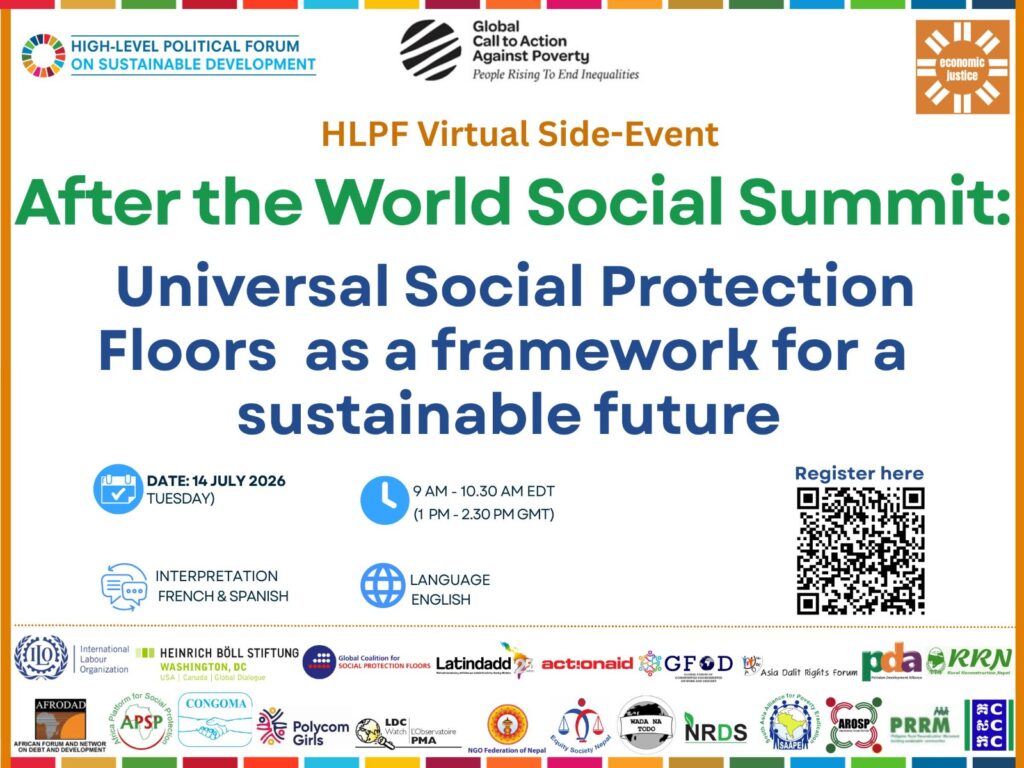
HLPF 2026 side event highlights Universal Social Protection Floors as the foundation for reducing inequality and building resilient societies.
Universal Social Protection Floors (USPF) must move from being a policy aspiration to becoming a central pillar of sustainable development, speakers emphasized during a High-Level Political Forum (HLPF) 2026 virtual side event organised by the Global Call to Action Against Poverty (GCAP) on 14 July.
The official virtual side event, “After the World Social Summit: Universal Social Protection Floors (USPF) as a Framework for a Sustainable Future,” brought together 128 participants including representatives from the United Nations, civil society organisations, development practitioners, grassroots communities and academia to discuss how the commitments made at the Second World Summit for Social Development (WSSD2) and the Doha Declaration can be translated into concrete national action.
Watch the recording of the event here.
The discussion opened with a powerful testimonial video produced by the Asia Dalit Rights Forum (ADRF), GCAP’s Social Justice Task Force. The video highlighted the healthcare access challenges faced by Dalit communities in Nepal, India and Bangladesh, emphasizing that equitable access to quality healthcare is a fundamental pillar of Universal Social Protection Floors. The video also showcased successful community-led interventions, particularly in Bangladesh, demonstrating how awareness, advocacy and collective action can improve access to health and social protection benefits for marginalised communities.
Christina Behrendt from the International Labour Organisation highlighted the significance of the Doha Declaration, describing it as a renewed global commitment to universal social protection. She stressed that social protection is a human right and an essential public investment that strengthens societies, reduces poverty and inequality, promotes gender equality, and supports inclusive economic development. She called on governments to expand fiscal space through progressive taxation, debt restructuring, tackling illicit financial flows and reprioritising public expenditure to ensure sustainable financing for social protection.
Sylvia Beales, from the Global Coalition for Social Protection Floors (GCSPF), underlined that the Doha Declaration provides an important political opportunity, but its success will depend on implementation at the national level. She stressed that governments must be held accountable for translating global commitments into national policies and budgets while ensuring that civil society actively participates in monitoring progress.
Speaking on financing social protection in the Philippines, Beckie Malay of the Philippine Rural Reconstruction Movement (PRRM) highlighted the crucial role of civil society in advocating for adequate public financing and inclusive policymaking. She shared experiences of citizen engagement in budget monitoring and policy advocacy while emphasising the need to ensure that social protection systems reach the most vulnerable populations.
Addressing the intersection of climate change and social protection, Katinka Weinberger of the United Nations Economic and Social Commission for Asia and the Pacific (UN ESCAP) argued that climate adaptation and social protection should no longer be treated as separate policy agendas. She noted that climate shocks are increasingly pushing vulnerable communities deeper into poverty and that adaptive social protection systems are essential for building resilience and safeguarding livelihoods.
The webinar also examined the global financing landscape. Patricia Miranda of Latindadd analysed the outcomes of the Fourth International Conference on Financing for Development (FFD4), noting that while important commitments had been made, significant challenges remain in mobilising adequate public resources for universal social protection. She stressed that debt burdens, austerity measures and unequal global financial structures continue to constrain investments in social development across many low- and middle-income countries.
During the interactive discussion, participants raised concerns about the growing debt crisis, declining Official Development Assistance (ODA), austerity policies and the influence of international financial institutions on social spending. Speakers highlighted that many countries, particularly in the Global South, are struggling to sustain social protection systems amid shrinking fiscal space and increasing debt servicing obligations.
Participants also debated whether expanding social protection alone is sufficient to reduce inequality. Responding to the discussion, speakers noted that while social protection plays a critical role in reducing poverty and income disparities, broader structural reforms—including progressive taxation, quality public services, gender equality, and addressing intersecting forms of discrimination—are equally essential for tackling inequality.
Participants called for stronger collaboration among civil society organisations, governments, United Nations agencies and research institutions to monitor implementation of the Doha Declaration and ensure governments are held accountable for delivering on their commitments.
Closing the webinar, Mariama Balde of the Heinrich Böll Stiftung Washington, DC described universal social protection as an investment in dignity, equality, resilience and sustainable development. She emphasised that while the Doha Declaration and recent global agreements provide an important political foundation, commitments must now be translated into concrete public investment, stronger partnerships and people-centred policies.
Concluding the event, Ingo Ritz thanked the speakers, participants, interpreters and the 23 co-organising organisations for their contributions. He reaffirmed GCAP’s commitment to working with the Global Coalition for Social Protection Floors (GCSPF) and partners worldwide to advance universal social protection as a key pathway towards achieving the Sustainable Development Goals and ensuring that no one is left behind.
Source: Global Call to Action Against Poverty (GCAP).